|
|
|
|
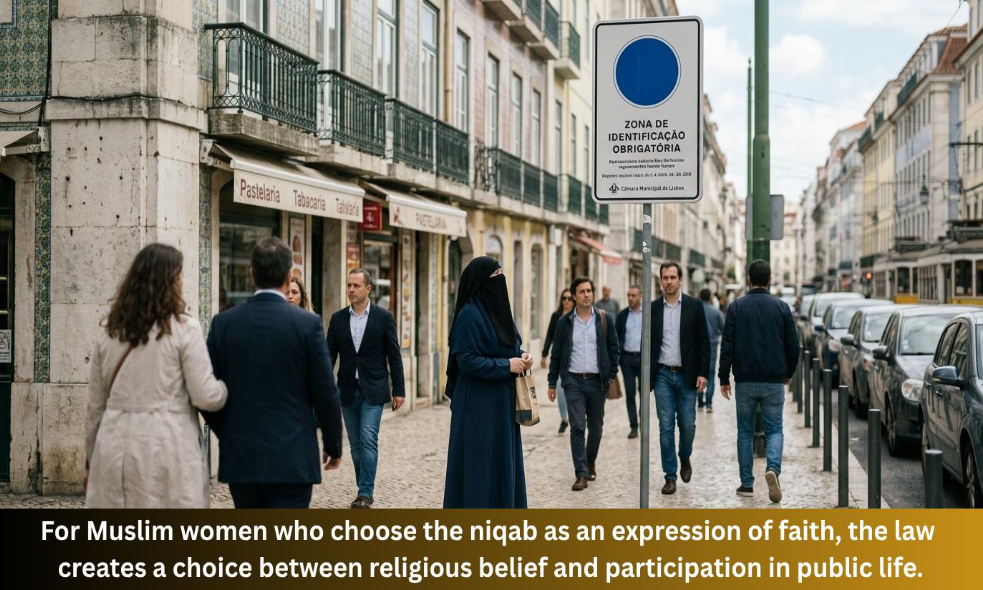
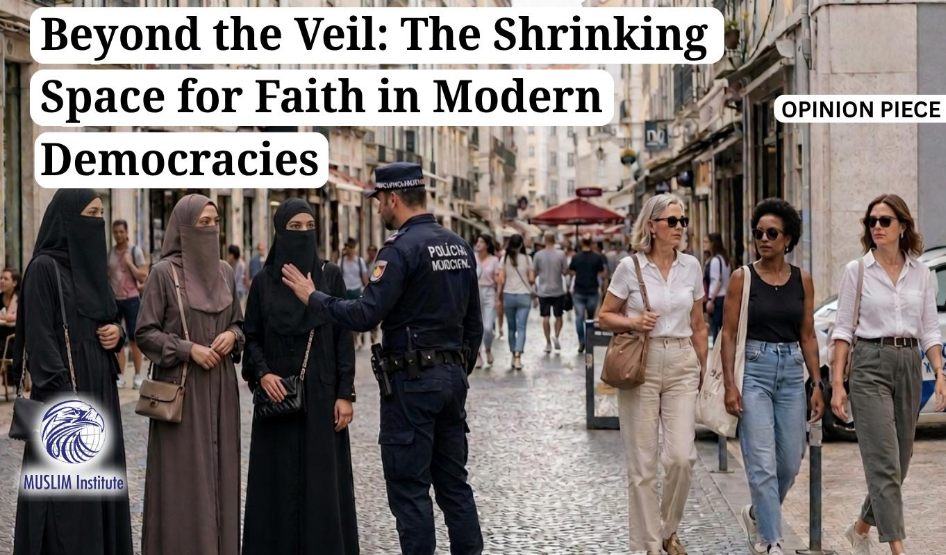
The recently enacted law in Portugal prohibiting facial concealment in public spaces spells out a significant shift in the country’s approach to democratic values and civil liberties. The said ban on face coverings directly affects Muslim women who choose to wear the niqab or burqa. While presented as a neutral measure to enhance public safety and social cohesion, the policy represents a governmental bar on personal expression and religious freedom.
The supporters of face-concealment bans in Europe, including earlier examples in France, Belgium, and Austria, claim that restricting religious face veils promotes gender equality and liberates women from patriarchal pressure. However, this premise is a fundamental paradox using state coercion to dictate what a woman cannot wear in the name of freedom. True autonomy empowers one to make choices. The state imposing bars on attire using financial penalties or law enforcement does not liberate individuals, rather it replaces one form of compulsion with another.
|
|
The niqab wearing women considering the expression of faith and personal devotion will deem such laws as regression to liberation. Further, also leave them with a painful choice between adhering to their deeply held religious beliefs and participating in public life.
|
|
|
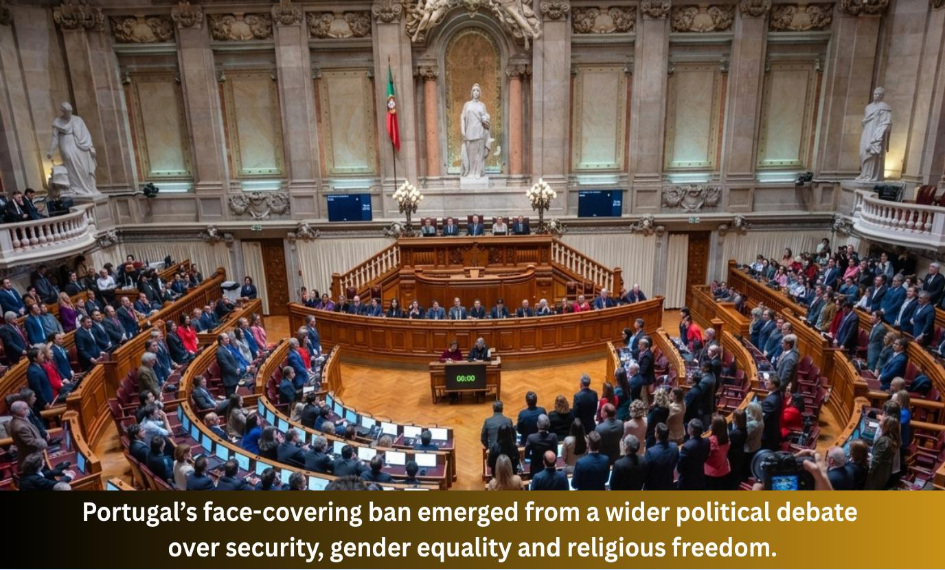
The far-right Chega party proposed the said veil ban bill. Implementing the law, President Antonio Jose Seguro stated, “The face must be considered a central element of human identity and communication”. The argument was opposed by the centre-left Socialist Party (PS), the green-left Livre, and the Portuguese Communist Party (PCP). They argued that the anti-veil bill could foster Islamophobia to its zenith. The Socialist Party criticised the bill, referring to it as an Islamophobic agenda, emphasizing the context of radicalism in which we live and the potential risks it poses to the communities directly affected.The Portuguese Communist Party argued that the proposal was unrelated to women's rights or security issues, and instead, it was aimed at promoting hate speech and violence against those who are different, thereby fueling racist and xenophobic rhetoric. Livre accused the right of hypocrisy and claimed that the debate was biased, attempting to create a “moral panic” in Portugal about a supposed Islamic invasion that the far right frequently references.
To comprehend the implications of the said legislation, one needs to look beyond the legal jargon employed to ensure constitutional compliance. This law seeks alignment with Article 41 of the Portuguese Constitution which guarantees freedom of religious expression. However, to circumvent the explicit constitutional protections, particularly Article 41, legislators have used apparently neutral drafting. Without referring explicitly to prohibiting Islamic attire, the statutory text employs a broad public safety argument and claims that visible identification is crucial for maintaining public order and civic trust. Acting as an illusion of legal neutrality, it allows supporters to argue that such prohibition applies universally to all facial concealment in public spaces.
|
|
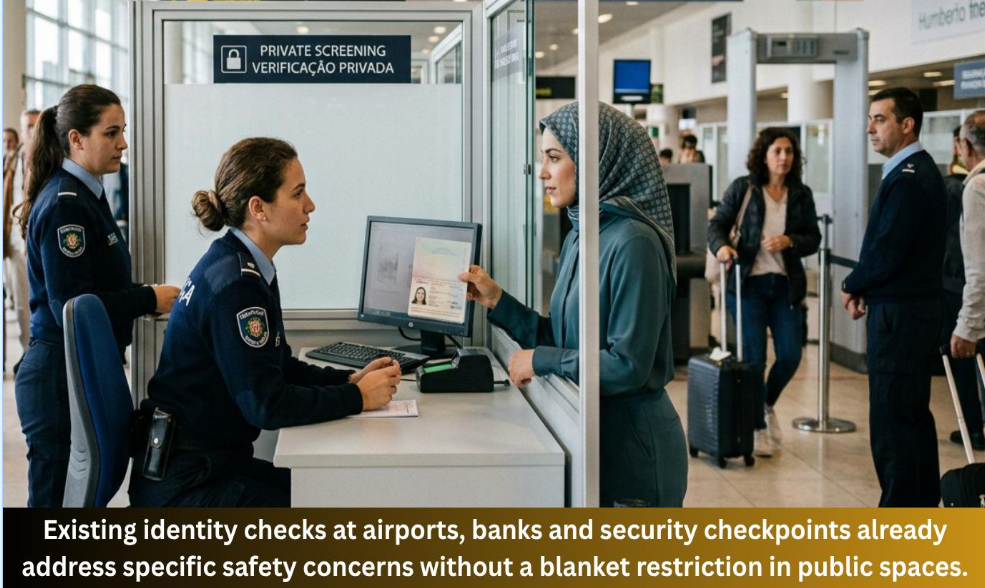
However, this defence quickly fails to withstand scrutiny. The existing Portuguese statutes enable law enforcement authorities to require identity verification at security checkpoints, banks, or airports when real public safety concerns arise. Adding a blanket ban on regular public streets turns a targeted security measure into an overreach that violates basic civil liberties.
A key flaw in the legal justification of the proposed bill is the list of selective exemptions contained in the clauses that directly contradict its claim of universal public safety necessity. On one hand, the bill imposes administrative fines ranging from €150 to €3,000 for wearing religious garments like the niqab while on other it allows exemptions for health masks, professional attire, cold-weather clothing, carnival costumes, and artistic performances. Permitting individuals to hide their faces for any secular, commercial, or medical reasons but placing a criminal charge when one covers it for religious practice. The legal framework reveals its discriminatory nature and disseminates multiple alternatives for those who wish to conceal their identity for malicious motives.
International human rights organizations such as Amnesty International have pointed out that using public order as a pretext to regulate religious expression fails to meet the legal standards of necessity and proportionality and further sets a troubling precedent for state-enforced wardrobe policing. The law establishes general prohibitions on face concealment in public by imposing financial penalties. The origin of this debate sparked by far-right political narratives makes it clear that the primary target of such legal measures is to challenge the expression of Muslim identity.
A historian and theorist, Joan Wallach Scott, in his landmark book “The Politics of the Veil” argues that Western legal restrictions on Islamic headscarves and face veils are seldom focused on individual religious expression, rather these restrictions serve as an overdetermined canvas for European states to project their anxieties about post-colonial racism, national identity, and social cohesion.
The analysis focuses on current European legislative actions, particularly Portugal's recent enactment of a public face-covering ban introduced by the far-right Chega party. Reflecting Scott’s analysis, Portuguese lawmakers omitted explicit references to Islamic attire (such as the burqa and niqab) to present the ban using universally applicable language pertaining to public security and gender parity, while international experts highlight that this law in particular targets and marginalizes Muslim women.
|
|
By implementing a law that affects a very small minority in the name of preserving national values and empowering women, Portugal exemplifies Scott’s central thesis: the female Muslim body continues to be regulated by European states as a political proxy to appease far-right populism and enforce cultural assimilation under the pretext of public safety.
|
|
Over the years, countries such as Austria,
Denmark, the Netherlands, Bulgaria, and
Switzerland have also implemented similar
legal frameworks although the specific scope
and enforcement mechanisms differ from one
jurisdiction to another.
|
|
|
When a state assumes the authority to dictate the clothing choices of its residents in public spaces, it sets a concerning precedent that harms the individual’s civil liberties. Current restrictions on religious attire provides foundation for any future interventions into personal choices. True social integration is built by legislating on the basis of mutual respect, dialogue, and equitable protection. This is not achieved by forcing individuals to choose between their faith and their right to walk freely in public spaces. A society to remain open and free must protect the rights of its members to express their identity without anxiety of state sanctions.
The use of “public safety” as a justification for putting a bar on face veils presents a stark contradiction in a country like Portugal, historically characterized by peaceful social cohesion where virtually no public security incidents involving Muslim attire have ever occurred.
Framing a few women as an existential threat to public order creates a panic based on unfounded security concerns. Instead of enhancing safety, enforcing a nationwide ban puts a significant administrative and operational burden on law enforcement. The municipal police and security forces will have to monitor, confront, and penalize individuals based on their attire, committing vital state resources. Creating a new public offence category related to personal religious expression, the legislator brings about unnecessary social tension requiring additional security oversight to manage an invented problem.
The passage of Decree No. 106/XVII by the Portuguese Parliament shows a pivotal shift in the legal regulation of religious expression in Southern Europe as part of broader socio-political efforts that disproportionately suppress Muslim presence in public spaces.
While proponents claim that it upholds gender parity and identity verification, a rigorous academic examination reveals that the statute contradicts core principles of the Portuguese Constitution, the European Union human rights frameworks, and binding international treaty obligations.
UN Special Rapporteur on Freedom of Religion or Belief Ahmed Shaheed observed in report A/HRC/43/48 (Para 27) that state policies restricting women's freedom regarding attire often rely on paternalistic assumptions that "infringe upon women's agency, autonomy, and self-determination" in contravention of international human rights obligations, including the Convention on the Elimination of All Forms of Discrimination Against Women (CEDAW). Shaheed also stated in report A/HRC/46/30 (Para 51) that general bans on full-face veils disproportionately affect Muslim women, serving to institutionalize anti-Muslim sentiment and entrench structural discrimination against them.
Former Special Rapporteur Heiner Bielefeldt refined this analysis in report A/68/290 (Para 53), affirming that restricting religious garments fails to treat women as "autonomous rights-holders" and that "state paternalism that denies women the capacity to decide on their own clothing under the justification of protecting them from coercion or defending societal norms directly conflicts with core equality and freedom of conscience standards".
As briefed in UN Special Rapporteur reports, enforced dress restrictions even framed as measures to combat gender oppression restrict women's participation in public life and worsen discrimination and social isolation (A/HRC/43/48, Para 43). Imposing economic sanctions upon women wearing religious garments compounds their vulnerability, forcing them into a coercive binary choice as mentioned earlier.
|
|
Under Article 26 of the Constitution of the Portuguese Republic (CPR) protecting personal identity and individual autonomy, and Article 41 CPR safeguarding religious freedom, the state cannot legally substitute its judgement for women’s moral framework.
|
|
|
This legal architecture acts as barrier to public mobility, violating international non-discrimination guarantees under Article 26 of the International Covenant on Civil and Political Rights (ICCPR) and Articles 2, 3, and 5 of CEDAW. As established by the UN Human Rights Committee in Yaker v. France (Communication No. 2747/2016) and Hebbadj v. France (Communication No. 2807/2016), blanket face-covering bans does not meet the strict criteria of necessity and proportionality under Article 18(3) ICCPR and cause systemic, intersectional discrimination. Special Rapporteur Ahmed Shaheed explicitly encouraged states in report A/HRC/46/30 (Para 78(d)) to repeal laws restricting women’s freedom to choose their dress including bans on religious garments in public spaces. In line with international human rights standards, Portugal's statutory prohibitions do not treat women as autonomous rights-holders, entrenching structural exclusion across public spaces.
|
|
As per Article 18(2) of the Constitution, any legislative limitation placed on fundamental rights must strictly adhere to the principle of proportionality. The State’s security objectives contradict this necessity threshold because context-specific identity checks, such as those already conducted at border controls, financial institutions, and security checkpoints, fully satisfy public safety requirements without instituting a blanket public exclusion. Further as per Article 13 of the Constitution prohibiting prejudice on religious grounds, a facially neutral rule that places its practical burden overwhelmingly on a discrete Muslim minority amounts to unlawful indirect discrimination.
In Eweida and Others v. The United Kingdom, the European Court of Human Rights (ECtHR) affirmed that religious attire constitutes a direct manifestation of belief having resilient protection under Article 9. Similarly, the Court of Justice of the European Union (CJEU), evaluating neutrality rules in Bougnaoui (C-188/15) and WABE (Joined Cases C-804/18 and C-341/19), ruled that subjective public discomfort, customer preferences, or generalized societal anxiety cannot legally serve as genuine operational requirements to restrict religious manifestations. Broad public unease regarding religious dress cannot override protected rights absent explicit operational necessity.
On the international level, the statutory ban directly violates Portugal’s binding treaty obligations under the International Covenant on Civil and Political Rights (ICCPR). Pursuant to Article 8 of the Portuguese Constitution, international treaty rules take significance and must guide the interpretation of domestic fundamental rights. Similarly in concurrent views Sonia Yaker v. France (Communication No. 2747/2016) and Miriana Hebbadj v. France (Communication No. 2807/2016), the United Nations Human Rights Committee (UNHRC) precisely evaluated an identical blanket ban and declared it a violation of Article 18 (Freedom of Religion) and Article 26 (Non-discrimination) of the ICCPR.
The UNHRC decisively rejected the
S.A.S. v. France rationale, holding that vague contentions of “social cohesion” or “living together” do
not meet the strict limitation criteria of Article 18(3) ICCPR. The Committee concluded blanket
prohibitions as disproportionate, failing to prove why targeted identity checks are insufficient,
and create intersectional discrimination that marginalizes Muslim women by confining them to the private sphere.
Concludingly framing face-covering bans as neutral administrative or security measures conceal their intense effect on religious pluralism and minority identity. Converting routine public appearance into a penal offence, the state creates a legal environment where the visible expression of Muslim identity is treated as inherently incompatible with public order. The Portuguese legal system explicitly incorporates international human rights instruments under Article 8 of its Constitution,
the views in Yaker and Hebbadj serve as a primary legal challenge to Decree No. 106/XVII. Therefore,
restricting fundamental constitutional freedoms on generalized social order grounds undermines the principles of equality,
religious liberty, and rule of law guaranteed across domestic, European, and international jurisprudence.
|
|
Author: Asif Tanveer Awan, LL.M, Research Associate, MUSLIM Institute.
|

P.O Box: 562, Islamabad, Pakistan | P.O Box: 780, Rickmansworth WD3 0NH, UK
info@muslim-institute.org | www.muslim-institute.org | unsubscribe
|
|