|
|
|
|
With the formal enforcement of the Maharashtra Freedom of Religion Act, 2026 (Maharashtra Dharma Swatantrya Adhiniyam, 2026), Maharashtra has become the 13th Indian state to impose statutory restrictions on religious conversion. State authorities and legislative supporters present the legislation as an urgent public order measure. The official policy rationale emphasises protecting vulnerable groups, particularly minors, women, and Scheduled Castes/Scheduled Tribes, from exploitative conversion practices, demographic manipulation, and dishonest interfaith marriages. Opposition parties, minority organisations, and civil society groups argue that the law is less about preventing genuine coercion and more about establishing state control.
They claim that existing penal provisions under the Bharatiya Nyaya Sanhita (BNS, the Indian Penal Code) already criminalise fraud, intimidation, and abduction, making specialised anti-conversion legislation politically motivated rather than legally warranted.
The Maharashtra Freedom of Religion Bill, 2026 prohibits religious conversions conducted through force, fraud, coercion, misrepresentation, marriage, or broadly defined “allurements”, such as gifts, employment, free education, divine healing, or material benefits, imposing penalties ranging from seven to ten years imprisonment and fines up to ₹7 lakh. The statute mandates a 60-day advance declaration to the District Magistrate before converting, establishes non-bailable offenses, shifts the burden of proof onto the accused, empowers police and blood relatives to file FIRs, voids marriages solemnized solely for unlawful conversion, and assigns child custody and maintenance to the mother while declaring that any offspring inherit her pre-marriage faith.
The introduction of anti-conversion statutes across BJP-governed states serves a clear political purpose. Electorally, these laws help consolidate the majority Hindu vote by translating ideological core promises into legal enforcement, neutralising internal caste divisions through a shared narrative of protecting demographic identity. By framing state intervention around safeguarding women, minors, and marginalised groups from coercive conversion or “Love Jihad”, the party shapes an emotive political agenda that mobilises Muslim hatred amongst its electorate ahead of competitive state elections, whilst putting secular opposition parties in a difficult ideological trap. Institutionally, these statutes expand state oversight over private choices and religious minority operations. By defining concepts like “allurement” broadly to include non-monetary aid, educational services, and charitable work, the law creates a framework that restricts the social reach of Christian missions, educational institutions, and NGOs that provide welfare to tribal and Dalit communities.
Ultimately, implementing standardised anti-conversion legislation across 13 states establishes a broad administrative template that institutionalises state control over personal belief, creating nationwide legal precedents that align state administrative machinery with national ideological objectives.
The legal mechanics of the Maharashtra Freedom of Religion Act 2026, present significant constitutional and procedural challenges. While the core principle that religious conversions must be entirely voluntary is widely accepted, and no credible legal stance supports forced, fraudulent, or deceptive conversions, the main concern revolves around how these statutes are structured and enforced. A careful examination of the text reveals that its drafting creates serious conflicts with constitutionally protected freedoms under Article 25 of the Indian Constitution (freedom of conscience and religion).
A major flaw in the legislation is its reliance on broad, vaguely defined terminology. Words like “allurement”, “undue influence”, and “misrepresentation” lack clear legal boundaries. In practice, such statutory ambiguity allows ordinary social welfare activities, such as running schools, operating hospitals, providing charitable relief, or conducting routine religious gatherings, to be misinterpreted as illegal inducements. When penal laws lack precise definitions, they fail basic standards of legal clarity and risk arbitrary enforcement against well-meaning charitable and religious organisations, while giving prosecutorial authorities wide discretion on pressing charges under ulterior motives.
Article 25(1) of the Indian Constitution protects the freedom of conscience and gives every person the right to profess, practise and propagate religion. This protection is important because religion is not merely an external activity; it is often deeply connected with a person’s identity, beliefs and moral choices. Therefore, individuals should generally have the freedom to choose, change or leave a religion according to their own conscience.
As the Supreme Court observed in Shafin Jahan v. Asokan K.M. (2018), the choice of faith is an essential requirement of personal liberty and human dignity.
|
|
Stripping an individual of their decisional autonomy over such intimate choices reduces them to a 'mere instrument of the State,' violating the core principles of privacy and self-determination established in Justice K.S. Puttaswamy v. Union of India (2017).
At the same time, this freedom does not mean that a person can be forced or deceived into changing religion. This balance between religious freedom and protection from coercion is central to the debate over anti-conversion laws.
The Supreme Court’s decision in Rev. Stainislaus v. State of Madhya Pradesh (1977) is often cited in support of the State’s authority to prevent conversion through force, fraud or coercion. The Court held this to be a legitimate objective because vulnerable people should be protected from exploitation in the name of religion.
However, preventing unlawful conversion is different from supervising every voluntary conversion. While the former can protect religious freedom, the latter may interfere with it. The constitutional question therefore becomes whether the State can prevent coercive practices without unnecessarily interfering with a person’s freedom of conscience and individual choice.
The Court has long recognised the centrality of propagating and preaching one’s religion to others under Article 25. In Ratilal Panachand Gandhi v. State of Bombay (1954), the Court held that “Article 25 guarantees to every person... not only the right to entertain such religious beliefs as may be approved of by his judgment or conscience but also to exhibit his belief and ideas in such overt acts as are enjoined or sanctioned by his religion and further to propagate and disseminate them for the edification of others.”
The Court looked at the right to propagate religion in isolation in Stainislaus, declaring the right to propagate religion does not extend to the right to convert as this would infringe on another person’s freedom of conscience. However, a year later, it took a wider view of the interplay between distinct constitutional rights. In Maneka Gandhi v. Union of India (1978), the Court recognised that the right to propagate religion is an extension of the freedom of speech (Article 19). The right to accept a propagated faith is an extension of personal liberty and choice (Article 21).
Justice Bhagwati ruled that “the fundamental rights conferred in Part III of the Constitution are not distinct nor mutually exclusive. Each freedom has different dimensions and merely because the limits of interference with one freedom are satisfied, the law is not freed from the necessity to meet the challenge of another guaranteed freedom. ... The right of a person to be deprived of his personal liberty has to stand a test of one or more of the fundamental rights conferred under Article 19.”
Therefore, state restrictions that criminalise persuasive religious speech or voluntary conversion fail because they unduly restrict multiple interlocking fundamental rights.
This question becomes even more important in light of the Supreme Court’s decision in K.S. Puttaswamy v. Union of India, which recognised privacy as a constitutional right and linked it with individual autonomy and decisional freedom. Religious belief can be understood as one of the most personal choices an individual can make. The same principle applies to interfaith marriages. Although the State has a legitimate interest in preventing fraudulent or forced marriages, an interfaith marriage by itself does not prove that a conversion was unlawful.
|
|
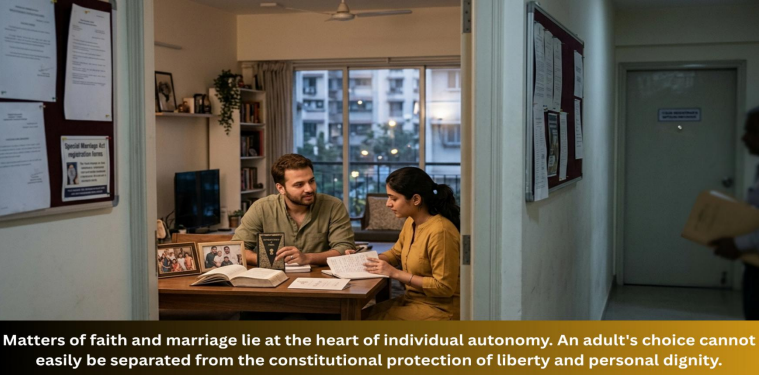
When two consenting adults of full mental competence freely choose their relationship and religious identity, their autonomy should be respected rather than questioned simply because their decision may be socially controversial.
|
|
|
The Supreme Court has explicitly stated that neither the state nor parents can interfere with an adult’s choice of partner in the case of Shafin Jahan v. Asokan K.M. (Hadiya Case) (2018), the Court held that “The choice of a partner whether within or outside marriage lies within the exclusive domain of each individual of choosing. Intimacies of marriage, including the choices which individuals make of a partner, lie within a core zone of privacy, which is inviolable... The Constitution guarantees to each individual the right to freely profess, practice and propagate religion.”
Article 25(2) gives the State powers to regulate the secular aspects of religious activity, such as managing temple finances, auditing waqf properties, or enacting social reforms like opening places of worship to all castes. Established
institutions like the Siddhivinayak Temple Trust and the Maharashtra State Board of Waqfs routinely operate under this constitutional mandate, where the government regulates money, property, and administration without interfering with core spiritual beliefs. In these cases, the State acts as a manager of secular assets, cleanly separating administrative oversight from an individual’s internal faith.
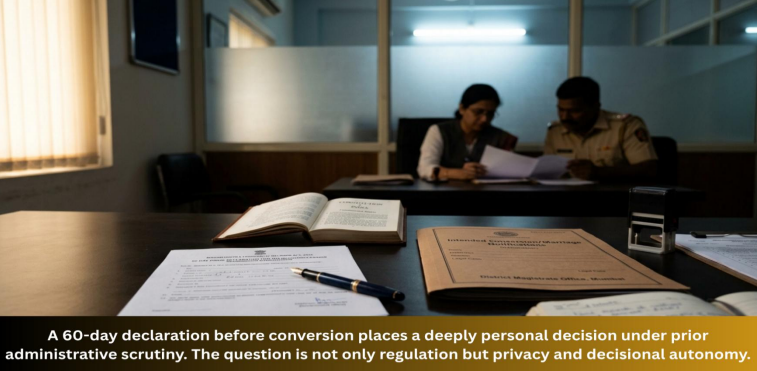
The Maharashtra Freedom of Religion Act, 2026 corrupts this constitutional balance by intruding into the inner core of personal conscience. Instead of regulating financial accounts or property titles of an institution, the 2026 law regulates the private, internal choices of individuals. By mandating a 60-day prior declaration to a magistrate, authorizing police inquiries into private relationships, and reversing the presumption of innocence, the statute
does not manage “secular activity.” It places a direct administrative veto over an adult’s personal decision to choose, change, or abandon a faith.
|
|
|
According to an RTI response from the Directorate of Government Printing and Stationery (DGPS), Mumbai, 1,687 individuals officially registered a religious conversion in Maharashtra between June 2014 and January 2018. Out of 1,166 Hindus who converted to other faiths, 664 chose Islam, 258 chose Buddhism, 138 chose Christianity, and 88 chose Jainism. Meanwhile, of the 263 Muslims who registered a change of religion, 228 (87%) converted to Hinduism. Overall, 44% of all official conversions during this 43-month period were to Islam and 21% were to Hinduism.
The Maharashtra law also raises concerns regarding criminal procedure, particularly where the burden of proving that a conversion was lawful is placed on the person involved in the conversion. Normally, the prosecution must establish the ingredients of a criminal offence, while reverse burdens require careful constitutional justification. Such a burden may be reasonable when the State has first established credible evidence of unlawful conduct, but it becomes
roblematic if the mere fact of conversion forces a person to prove their innocence. Similarly, special protection for women, minors and vulnerable persons is justified when they face coercion or exploitation, but protection should not become paternalism. An adult woman can require protection from coercion while still possessing the constitutional capacity to make her own religious decisions.
|
|
A person must be protected from being forced to change religion, but that same person must also be protected in the freedom to change religion voluntarily. The real measure of the law, therefore, is whether it can prevent coercion while preserving the fundamental freedom of conscience.
|
|
|
Therefore, the constitutionality of the Maharashtra Freedom of Religion Act cannot be answered simply with a “yes” or “no.” The State clearly has the authority to prevent force, fraud and coercion, but every restriction must also satisfy constitutional principles of necessity, proportionality and personal liberty. The central issue is whether the law protects individuals from unlawful conversion without placing unnecessary restrictions
on voluntary religious choice. Ultimately, the constitutional balance should be clear:
The Act also introduces severe procedural measures that undermine individual autonomy and standard legal protections. By permitting blood relatives to file a “First Information Report” (FIR) without the consent or involvement of the person who has converted, the law effectively overrides adult agency. This creates a statutory mechanism for family members to veto personal choices, often targeting interfaith couples or individuals
exercising their right to conscience.
In the recent case of Rajendra Bihari Lal v. State of Uttar Pradesh (2025), the Supreme Court quashed mass-conversion FIRs lodged by third-party political/communal outfits, ruling that allowing unrelated third parties to file complaints leads to the weaponisation of the law and directly bypasses procedural firewalls intended to protect genuine freedom of conscience.
Additionally, granting police officers authority to initiate investigations on their own initiative (suo motu), without a complaint from the affected individual, fosters an environment of administrative surveillance. Private prayer meetings, community services, and minority-run
institutions become susceptible to unwarranted scrutiny and interference. By making offences non-bailable and placing the burden of proof on the accused to demonstrate that a conversion was voluntary, the law reverses traditional principles of criminal justice. An individual or leader is presumed guilty upon suspicion, often resulting in extended detention before trial, even if the allegations are later proven false.
Furthermore, complex declaration requirements and mandatory public notification periods expose individuals and interfaith couples to social pressure, harassment, and public exposure. Instead of safeguarding citizens, these procedural obstacles discourage individuals from freely exercising their constitutional right to marry or follow their faith and choice. When evaluating these statutory features together, the law moves beyond regulating coercive practices and instead constructs a framework of administrative oversight over personal belief, raising profound constitutional questions about privacy, equality, and fundamental liberty. The statutory provisions of the Maharashtra Freedom of Religion Act, 2026 run directly counter to well-established jurisprudence settled by the
Supreme Court of India. Two landmark judgments in particular set clear constitutional boundaries regarding personal liberty, boundaries that this legislation directly challenges.
In Justice K.S. Puttaswamy v. Union of India (2017), a nine-judge bench of the Supreme Court unanimously affirmed that the right to privacy is a fundamental right protected under Article 21 of the Constitution. The Court explicitly recognized two vital components of this right: informational privacy, which protects a citizen’s control over personal details, and decisional privacy, which guarantees freedom from state interference when making core life choices.
|
|
By mandating a 60-day advance notification to a District Magistrate prior to any conversion, the statute forces individuals to expose an internal matter of conscience to public and administrative scrutiny. This requirement effectively subjects an intimate, private decision to state oversight, violating the guarantee of decisional privacy.
|
|
|
In its ruling in Evangelical Fellowship of India v. State of Himachal Pradesh (2012), the Himachal Pradesh High Court held that "A person’s belief or religion is something very personal to him... To ask a person of his intention to change his religion and then to give wide publicity to the same would be a violation of his fundamental right to privacy and freedom of conscience... [It] may also endanger the life of the person concerned."
Similarly, in Lata Singh v. State of U.P. (2006), the Supreme Court ruled that an adult individual possesses an absolute right to make personal choices, including marriage and faith, without fear of external interference. The Court made it clear that neither family members, local communities, nor state authorities hold any legal standing to veto or dictate an adult’s choices regarding inter-faith or inter-caste relationships.
The 2026 Act undermines this principle by expanding locus standi to allow third-party blood relatives to file police complaints. Granting family members the power to initiate criminal proceedings against a personal choice effectively creates a statutory mechanism for private vetoes, eroding individual autonomy in direct opposition to binding precedent.
|
|
|
The enactment of the Maharashtra Freedom of Religion Act, 2026 will also subject Muslims, Christians, and other religious minorities to heightened state surveillance, as mandatory prior notifications and third-party complaint provisions directly intrude upon private decisions of faith and interfaith marriages. Vaguely defined terms such as “allurement” risk criminalizing routine social, educational, and medical charity work conducted by minority institutions, exposing leaders and community workers to frivolous police cases. Furthermore, by classifying offenses as non-bailable and shifting the burden of proof onto the accused, the legal framework increases the threat of prolonged pre-trial incarceration and social harassment against minority communities.
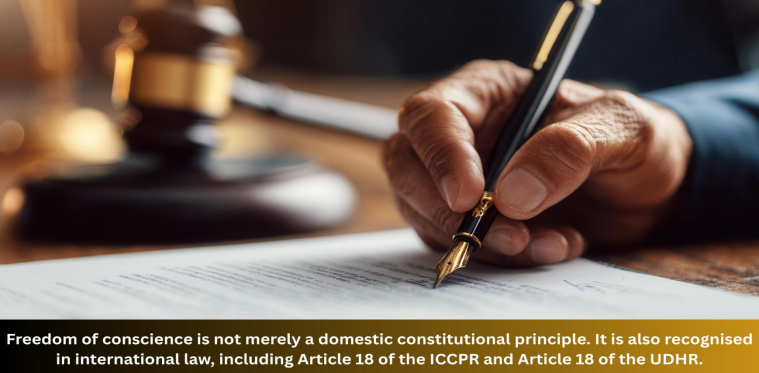
Beyond its domestic constitutional frailties, the Maharashtra Freedom of Religion Act, 2026 places India in direct contravention of its international legal commitments, most notably Article 18 of the International Covenant on Civil and Political Rights (ICCPR), which India ratified on April 10, 1979. As elaborated in UN Human Rights Committee General Comment No. 22, Article 18 protects the internal forum internum of individual conscience from all forms of state coercion, explicitly guaranteeing the unconditional freedom to adopt or change one's belief.
By subjecting an individual’s personal choice of faith to mandatory 60-day prior administrative notice, executive scrutiny, and an inverted burden of proof, the statute constructs a regime of prior restraint that breaches Article 18 of the Universal Declaration of Human Rights (UDHR) and the 1981 UN Declaration on the Elimination of All Forms of Intolerance and Discrimination Based on
Religion or Belief. Furthermore, by criminalizing standard social welfare under overbroad definitions of 'allurement,' the legislation weaponize state machinery to policing minority conscience, undermining global norms of religious freedom and international customary law.
|
|
|
In Conclusion relies on manufactured moral panic to weaponize state machinery against personal autonomy and interfaith relationships. By mandating advance notices to administrative authorities and empowering third parties to lodge complaints, the statute transforms private decisions of faith into regulated administrative procedures. This statutory scheme directly curtails the fundamental freedom guaranteed under Article 25 to adopt, retain, or change one's faith without state interference. Furthermore, vaguely defined terms and non-bailable penal structures shift the burden of proof onto the accused, enabling widespread surveillance and institutional harassment against religious minorities and consenting adults. Rather than offering genuine protection against coercion, the legislation criminalizes personal choice and transforms private conscience into a matter of state oversight.
Ultimately, this framework undermines the core constitutional guarantees of privacy, equality, and secularism established by Supreme Court jurisprudence.
|
|
Author: Asif Tanveer Awan, LL.M, Research Associate, MUSLIM Institute.
|

P.O Box: 562, Islamabad, Pakistan | P.O Box: 780, Rickmansworth WD3 0NH, UK
info@muslim-institute.org | www.muslim-institute.org | unsubscribe
|
|


